When I See Through You
The Two Shadows
By noon on the Fourth of July, three women had called Rose Ashford Vale a vision, two boys had dropped things trying not to stare at her, and Ray had already shouted her name across the church grove as if she were something he had won.
There was a war on the far side of the world that summer, but it had not yet learned the road to Coweta County. So the whole county put on its second-best clothes, good enough for church but not so good they could not risk grass stains, and came down to the grove by the river to eat too much, court too openly, and pretend with their entire hearts that the radio had been making the foreign parts up.
Rose Ashford Vale was sixteen years old and at the very top of her powers.
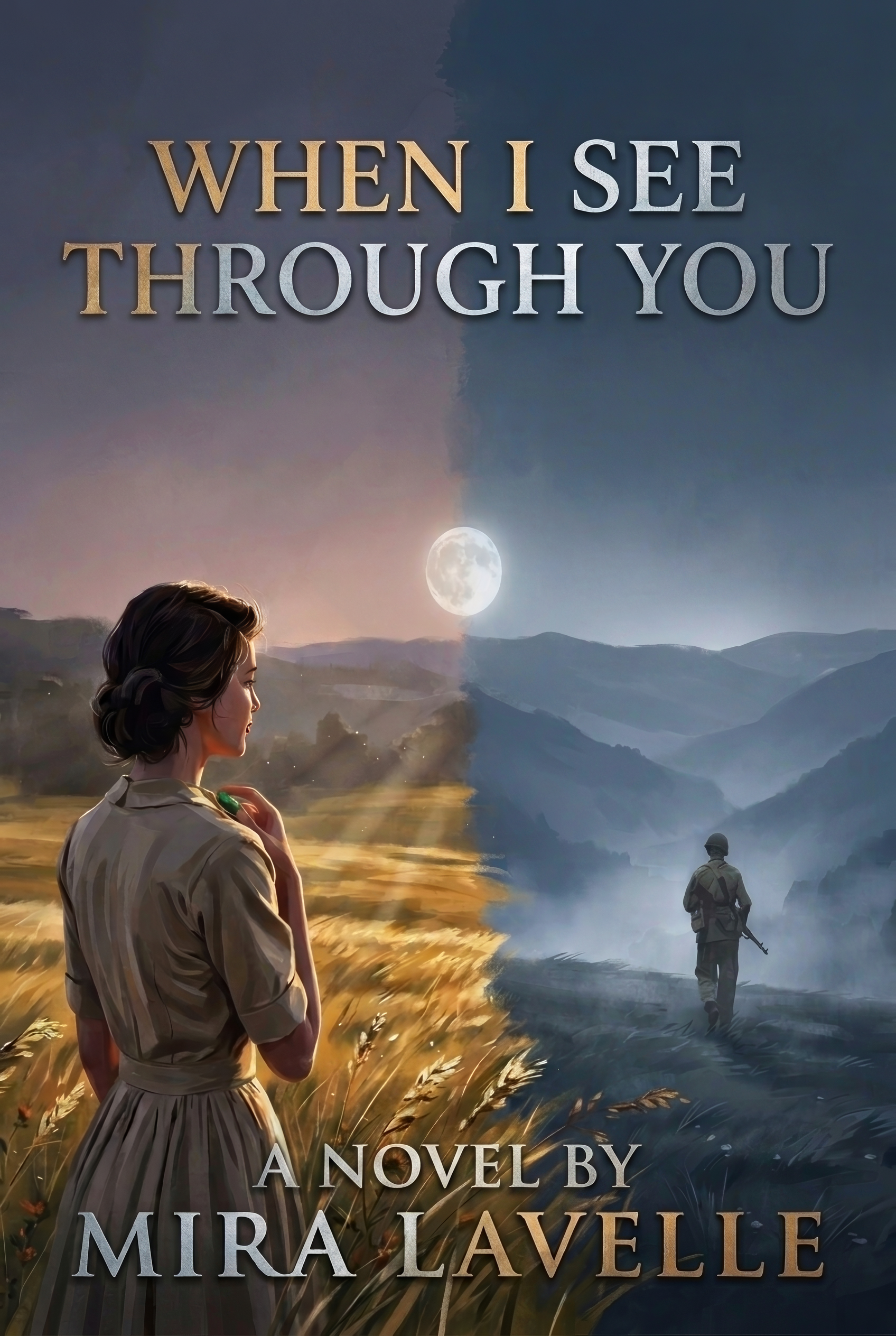
She knew it, too, which was half of what made it true. She had on a yellow lawn dress, fine cotton worn soft from washing, that her mother had let down twice and that fit, this final summer of its usefulness, as though it had been cut for exactly the girl Rose had turned out to be. She had washed her hair in rainwater and rosemary so that it took the damp and curled the way the county liked. At her throat, on its black ribbon, lay the little green heart of jade that had been her grandmother’s, cool against her breastbone even in the July heat, the way it always was, which she had long since stopped finding strange. She moved through the grove the way a good swimmer moves through familiar water: easily, faster than she appeared to, and with a private knowledge of where the cold currents ran.
“Rose Vale,” said the banker’s wife, “you are a vision.”
“Mrs. Pruitt, you are a saint to say so and a liar to mean it, and I love you for both,” said Rose, and kissed the powdered cheek, and was gone before the woman had finished being charmed. Rose knew better than to linger after the room had given her what she wanted.
The grove had been doing this on the Fourth for sixty years and knew its own choreography. The men talked cotton and weather and, in low voices the wives pretended not to hear, the thing in Europe. The women held the long tables under the oaks. The old ones sat in the shade and judged. And the young people moved in bright slow loops, looking idle while doing the grove’s most serious work: arranging who would marry whom.
Two of the loops, that summer, bent toward Rose, and the county had even, in the manner of counties, given the thing a name. The two shadows, they called the Mercer boy and the Dalton boy, because wherever Rose Vale’s yellow dress went, two young men went after it in their two different ways: the one out in front of her like sunshine, the other a step behind and to the side, quiet, where you did not see him until you turned your head.
Ray was the sunshine, and he arrived now exactly like it, all at once and warm and impossible to look straight at.
“There she is,” he said, loud enough for three tables. “There’s the prettiest girl in the state of Georgia, and would you look, she’s standing here all by her lonesome like nobody in this county has the sense God gave a goose. Rosie. Rosie. Come win something.”
“I don’t need to win anything, Ray, I have everything I want and most of what I don’t.”
“Come watch me win you something, then,” he said, which was the truer offer, and held out his arm, and grinned the grin, the gold Dalton grin that arrived a half-second ahead of the rest of him and that had been opening doors and loosening purse-strings for that family since before the War Between the States. Rose took the arm. Of course she took the arm. A girl did not refuse Ray in the middle of the grove on the Fourth of July; she would as soon have refused the weather.
He walked her to the ring-toss the way a man walks a prize horse past the men he means to sell it to. At the booth he paid for six rings and missed with five of them so handsomely that the small crowd which had naturally formed liked him better for the missing than they would have for clean throwing. When a little Hendrix boy groaned at the fifth miss, Ray clutched his heart and staggered backward so grandly the child forgot to be disappointed and shrieked with laughter. That was Ray’s gift, and it was a real one: he could make even losing feel like a party.
On the sixth ring he ringed the tall peg, and the boy handed down a china dog with a gold collar, and Ray presented it to Rose with a bow that had Charleston in it somewhere, and the crowd made the sound a crowd makes, and Rose laughed and pressed the china dog to her heart as though it were the answer to a question she had been asking her whole life.
“Raymond Dalton,” she said, “you have ruined every other boy in this grove and I hope you are ashamed of yourself.”
“Not even a little,” said Ray, delighted, and meant it. He stood half a head above the crowd and let himself be looked at. Ray was always most himself in the warm center of every eye.
Rose carried the china dog to the long table and set it down and admired it loudly for the women, and then, when the loop of attention had rolled on past her, she stood for one moment with her hand resting on the ugly little thing. Behind the bright voice, in the cool room where Rose kept her true opinions, she thought: He chose the dog for himself. A whole year of courting, and Ray had never once asked what she would choose. She set the thought aside, where she kept such things, without heat.
The other shadow she found, as she nearly always found him, by not looking for him.
Jack Mercer was over by the bandstand, on one knee in the dust, doing something to the fiddle player’s chair.
Rose drifted that way along the edge of the dancing-ground, greeting as she went: old Mr. Calloway, who was ninety and frightening and adored her; the Cole girls; a small barefoot Hendrix child was crying over a dropped slice of cake, and Rose gave him her own untouched piece with no audience and no change in her real face - just a quick, fierce whisper that the fallen slice had been meant for the ants, who were also God’s creatures and were having a finer Fourth than anybody. She reached the bandstand as though she’d washed up there by current.
The fiddler, old Tom Pruitt, had been about to give up the evening. The cane chair he played from had thrown a leg, and a fiddler cannot stand for four hours at sixty-eight, and there had been a general air of the music being over before it had rightly begun. Jack had not said much about it. Jack did not say much about anything. He had simply gone down on one knee with a pocketknife and a length of baling wire some farmer always had. Now he was drawing the wire tight around the split leg, thumb braced against the cane seat, twisting until the chair stopped shivering under his hand. He worked with the slow exact patience of a man who had mended ten thousand things nobody thanked him for, his dark head bent, his brown hands sure.
“There,” he said, to the chair, not to anyone. He set it upright and put his own weight on it, testing, the way he tested everything, and the leg held. “Try it now, Mr. Pruitt.”
Old Tom sat. The chair held. The fiddle came up under his chin, and after a moment the first long note of it went out over the grove, and the dancing-ground, which had been about to disperse into a disappointed dusk, gathered itself instead and began to turn.
Nobody clapped for Jack. Nobody had seen, exactly, that there had been anything to clap for; the music had stopped and then the music had started, and that was all the grove knew. Ray had given one girl a china dog in front of two hundred people. Jack had given two hundred people four hours of dancing and gone unremarked back to the rail, to the edge of things, where he had learned to live.
Rose saw the whole of it. She had been raised to, by a mother who never once said so.
She did not go to him directly. She finished her loop, she was always finishing a loop, and came to rest at the rail a courteous yard from him, facing the dancing, so that anyone watching would see only Rose Vale catching her breath at the edge of the floor, and the Mercer boy happening to be near. Jack did not ask her to come closer. He only made room at the rail, as if room were a thing a person ought to be given without ceremony.
“You fixed Mr. Pruitt’s chair,” she said, to the dancers.
“It wanted wire,” Jack said, to the dancers.
“You could have let it want wire and gone and stood by the pit with the men and nobody would have thought a thing of you.”
“I’d have known the chair was broken,” Jack said, as though this settled it, which for Jack it did. He was quiet a moment. Then, in the careful tilted economy she had begun, that year, to collect and translate the way other girls collected pressed flowers: “Ray won you a dog.”
“Ray won me a dog.”
“It’s a homely dog.”
“It is the homeliest dog in the state of Georgia,” Rose said warmly, “and I am going to keep it on my windowsill until I die.”
“Windowsill’s a high honor,” Jack said.
“For an ugly dog, yes.”
And she felt Jack, beside her, do the thing he did that was not quite a smile: the quarter-inch shift at the corner of his mouth, which she received and did not look over to confirm. She had felt it the way you feel the sun come out behind you, on the back of the neck, without turning around.
The fireworks came after full dark.
The county had pooled for them, a poor year’s worth, a dozen good shells and a deal of smaller stuff, and everyone lay back on quilts on the slope above the river and waited. The children went feral in the dark. The courting couples found, in the general upward-tilting of every face, a rare unwatched minute that the grove pretended not to grant and granted anyway, once a year, on the Fourth.
Ray had got Rose onto the Dalton quilt, naturally. Ray got Rose onto things. He lay propped on one elbow beside her, predicting each firework before it opened. Here comes a red one, Rosie, I can feel it, watch the red one. And he was, in the flowering light, so purely and uncomplicatedly handsome that Rose felt the old true pull of him, the unmistakable county-wide agreement about Ray, and did not pretend to herself that she didn’t.
But when the big green shell went up, the best of the poor dozen, a great soft chrysanthemum of green fire that hung over the river and laid its light down over the whole upturned county, Rose did not watch the green fire.
She turned her head.
***
Enjoying the story?
Continue reading in the full novel.
Releases August 15, 2026.